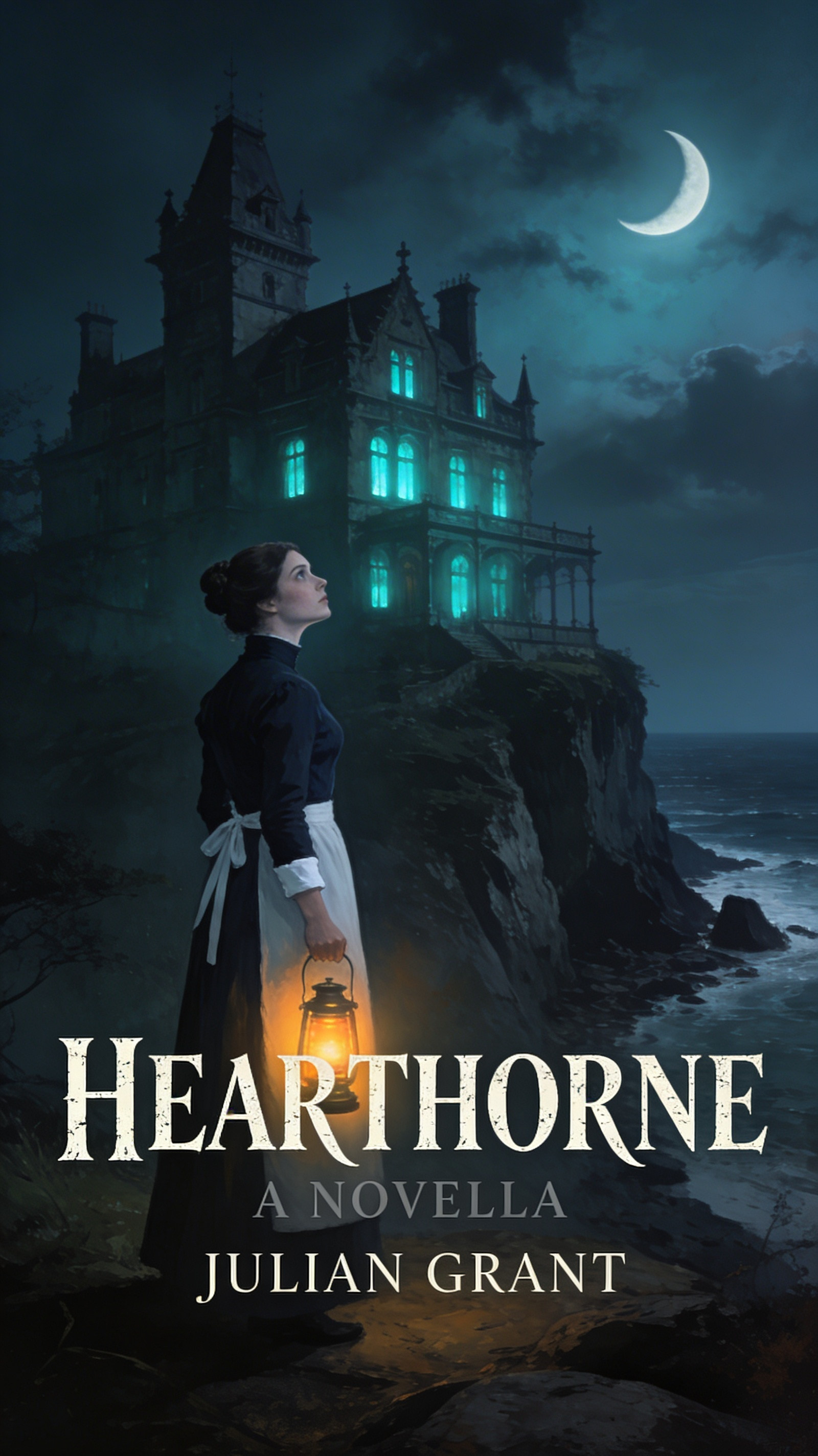

A Letter Found Among the Effects of Benjamin Wrexham, Groundskeeper
Written: December 24th, 1870
Discovered: March 1871, Following His Death
To Whom It May Concern, or Perhaps to No One At All,
I placed the stone at dawn on December the twenty-second. My hands have carved twenty-nine others before it, each letter and date pressed deep into the limestone we quarry from the fens themselves. Thirty stones now stand in that quiet corner of the estate grounds, half-hidden by winter bracken. Thirty women. Thirty solstice nights. Thirty times I have watched, helpless, as understanding came too late to matter.
I am an old man now, sixty-three years upon this earth, forty of them spent at Hearthorne. I have seen things that would make learned men call me mad, and I have kept my silence because silence is all that remains to me. But I am tired, and my heart troubles me of late, and I think perhaps it is time someone wrote it down. Not for prevention, the pattern cannot be broken, I know this now, but for testimony. For witness. So that someone, someday, might understand that these women were not lost to accident or madness. They were claimed. They went willingly. And I could do nothing but watch, and grieve, and place the stones.
Miss Chalmers arrived on the fourteenth of October. A fine young woman, strong and capable, with the practical manner of one trained to nursing. Lady Soames had engaged her as companion, though we all knew—those of us who have served here long enough—that "companion" was merely the word used for what she truly was. The latest offering. The thirtieth bride.
I saw the mark on her wrist the first day. They always bear it, though they never remember how it came to be there. A touch in childhood, innocent enough at the time. A paddling pool in Brighton. A wealthy woman's hand upon a seven-year-old girl's arm, gentle and brief. Fifteen years later, the summons comes, and they cannot refuse. Their bodies know the call, though their minds do not understand it until transformation has already begun.
By December the twentieth, Miss Chalmers—I cannot bring myself to use her Christian name, though she bid me do so in her kindness—had changed so completely that to look upon her was to see a creature caught between worlds. Her skin bore that peculiar, mottled quality I have learned to recognize, dark patterns flowing across pale flesh like moonlight through water. The marks along her ribs and throat moved with each breath. Gills, unmistakable now, opening and closing in rhythms that had nothing to do with air. Beautiful in their way, like mother-of-pearl inlay. Terrible in their implication.
Her eyes had changed most of all. The pupils had lengthened to vertical slits, catching the light like a cat's. But no cat has ever looked at a man with such alien awareness, such perfect comprehension of depths that no human was meant to witness.
She spent that final day almost entirely in water. The bathing room, the rain barrel, the pond. Anywhere liquid gathered, she would submerge, sometimes for twenty minutes or more. I passed by the pond at noon and saw her beneath the surface, perfectly still, her altered eyes open and unblinking. She looked at peace. She looked like she was finally home.
Lady Soames moved through the house that day with the satisfaction of a task well-executed. She is ageless, that one—I was a young man when I came to Hearthorne, and she looked then precisely as she looks now. I do not know what she is, not truly. Human in form, perhaps, but something older moves behind her eyes. Something that knows the water's secrets.
She dressed that day in deep blue-green silk that seemed to shift in the light like water itself. The scent of elderberry followed her through the corridors, sweet and cloying. I saw her in the garden in the afternoon, standing among the memorial stones, running her fingers over the carved names. She smiled. Not with cruelty, but with genuine affection. She loved them, I think, in her way. Loves them still, though they belong now to cold and darkness and pressure that would crush my bones to powder.
Evening came, and with it the longest night of the year. Winter solstice. Always winter solstice. The pattern demands it, when darkness sits heaviest upon the land and the veil between worlds grows thin.
I saw Lady Soames go to Miss Chalmers' room at eight o'clock. I was in the corridor, attending to lamps, and I heard through the door that language they speak together. Not English. Not any tongue I have ever heard spoken by human mouths. It sounds like water moving through limestone channels, like currents pulling through deep places, like the whisper of the tide against ancient rocks. I do not understand the words, but I know what they mean. They mean: It is time. Are you ready? Will you come willingly?
And Miss Chalmers answered in the same language, her voice eager, almost desperate with wanting.
When Lady Soames emerged, perhaps twenty minutes later, she saw me in the corridor. Our eyes met. She did not smile, but something passed across her face—recognition, perhaps, of my role in all of this. The eternal witness. The one who places stones.
She told me that Miss Chalmers was ready. More than ready. That she goes with joy, and I should remember that, when I grieve. She goes with joy.
I could not answer. My throat had closed around words I had spoken before, to her, after other rituals. Pleas that went unheeded. Protests that changed nothing. So I only nodded, and she swept past me toward her own chambers, leaving the scent of elderberry hanging in the air like a benediction or a curse.
At eleven-forty-five, Miss Chalmers emerged from her room.
She wore only a thin white shift, near-transparent muslin that clung to her altered form. The December night was bitter cold, frost already forming on the windows, but she moved as though through summer warmth. The cold meant nothing to her now. Her body had adapted to temperatures that would stop my heart.
I was waiting in the entrance hall. I had not decided to wait there—my feet had simply carried me, knowing, as they have known twenty-nine times before, that I must witness. I must see. It is my penance and my duty.
She saw me standing there and paused. Her face—still recognizable as the face of the practical young nurse who had arrived two months prior, but transformed by something that moved beneath the skin—softened with kindness.
She spoke to me then, her words coming slowly, carefully shaped, for English was difficult for her now. She told me I need not watch, need not grieve. But I answered that I must, that I had always watched, that I would watch until I could no longer. It is my penance and my duty.
She studied me with those vertical-pupiled eyes, and I thought I saw understanding there. Perhaps even gratitude, that someone would remember her as she had been before the water claimed her fully. She thanked me—for witness, for stones, for remembering.
She smiled then, and turned toward the door. Her bare feet made no sound on the floor.
I followed at a distance as she walked out into the winter night.
Lady Soames was already outside, standing on the frost-silvered lawn, her blue-green gown dark as deep water in the moonlight. She did not approach Miss Chalmers, did not take her hand or guide her steps. There was no need. The path was written into the young woman's bones now, inscribed into her very cells through eight weeks of systematic transformation.
Miss Chalmers walked steadily across the grounds toward the fen-edge. Her pace was neither hurried nor reluctant. She moved with the certainty of water flowing downhill, following the only course possible to it. Inevitable. Perfect. Terrible.
The moon was three-quarters full, bright enough to cast shadows. It painted the world in silver and black, making the familiar grounds strange and dreamlike. Miss Chalmers' mottled skin seemed to glow faintly in that light, phosphorescent, as though she had already begun to generate her own illumination for the darkness that awaited her.
She hummed as she walked. A melody without words, rising and falling like the tide. I recognized it as the same song I had heard her singing in her sleep weeks ago, when the transformation was just beginning. Now she sang it fully, and it was not a human sound. It was the voice of deep water, of limestone passages worn smooth by centuries, of something vast and patient that waited in darkness below.
Lady Soames walked parallel to her, keeping pace but maintaining distance. I followed both, keeping to the shadows of the tree line. No one acknowledged my presence. We were all three players in a drama that had unfolded twenty-nine times before, each of us knowing our roles perfectly.
The boat landing appeared ahead. A small wooden dock, ancient and weathered, jutting out into a deep channel where the fen water ran dark and swift. This channel connects to the limestone caves beneath the estate, passages that descend deeper than any man has mapped, reaching down to chambers where pressure and cold would kill any ordinary human in moments.
But Miss Chalmers was no longer ordinary.
Around the boat landing, barely visible in the shadows, stood the memorial stones. I had placed each one myself, carving the names with hands that grew steadier with practice, though my heart never hardened to the task. Twenty-nine women, ranging from age eighteen to thirty-two, each one marked in childhood, each one summoned in their prime, each one transformed over eight weeks, each one walking willingly into water on the solstice night.
And now the thirtieth would join them.
Miss Chalmers reached the water's edge at eleven fifty-seven. I know the time because I pulled out my pocket watch, though I do not know why. Perhaps to ground myself in the solid reality of hours and minutes, when everything else felt like dream or nightmare.
She stood at the dock's end, looking down into black water. The channel was perhaps twenty feet deep at this point, though it descended much deeper farther along. The water moved sluggishly, thick with winter cold. Ice had formed at the edges, thin sheets that fractured the moonlight.
Lady Soames remained on the shore, her hands folded before her, her face serene. She began to speak in that underwater language, words I could not understand but which resonated in my chest like distant thunder. Blessing, perhaps. Or farewell. Or welcome to sisterhood.
Miss Chalmers turned her head slightly toward Lady Soames and responded in the same tongue. Her voice was stronger now, more fluid, shaped by a mouth that had learned to form sounds meant for water rather than air.
Then she turned back to face the channel, and I saw her expression clearly in the moonlight.
She was smiling.
Not the smile of someone resigned to terrible fate. Not the smile of someone brave in the face of death. This was joy. Pure, uncomplicated joy. The smile of someone who has been kept waiting too long, and who finally, *finally*, receives what they have desperately wanted.
At precisely midnight—I felt it rather than saw it, a shift in the air, a change in the quality of darkness—Miss Chalmers stepped forward into the water.
She did not ease in gradually. She walked straight off the dock, disappearing beneath the surface with barely a splash. The water closed over her head like a door closing, smooth and final.
For a moment, nothing. Then I saw movement beneath the surface. Her pale form, glowing faintly, swimming downward with inhuman grace. No struggle. No hesitation. Her body moved as though it had never known air, as though water had always been its natural element.
The gill marks along her ribs opened fully, and even from the shore I could see them flexing, pulling oxygen from water that should have drowned her. Her legs moved together, undulating like a single limb, propelling her deeper.
A trail of phosphorescence followed her descent, like fireflies in the darkness. Deeper. Deeper still. The channel swallowed her, and then the limestone passages beyond the channel, descending to places where no light had ever reached, where pressure measured in tons per inch awaited, where something vast and ancient had been waiting for her since she was marked at age seven.
The phosphorescent trail faded gradually, sinking deeper, until it was just a faint glow in the absolute darkness below. And then it was gone.
Miss Beatrix Chalmers, twenty-four years old, trained nurse from London, daughter of a merchant family, lover of poetry and pressed flowers and the smell of old books, was gone into the deep.
Lady Soames watched until the last trace of light disappeared. Then she turned to me, she had known I was there all along, of course—and regarded me with those ageless eyes.
She said simply that it was done, that the pattern continues as it has, as it must, as it will.
I asked her—more boldly than I ever had before—whether it must truly continue. Whether there was any necessity to this horror.
She answered without hesitation that yes, the covenant demands it, that the waters require it. And they go willingly, she reminded me. I had seen Miss Chalmers' face. I had seen her joy.
I told her then what I had long thought but never dared speak: that I had seen a woman conditioned to want her own transformation, eight weeks of systematic change that left her no choice but to desire what she had become.
Lady Soames considered me as one might consider an insect that had learned to speak. She asked whether that is not the nature of all desire, of all becoming—that we are shaped by our circumstances until we want what we were made to want. Miss Chalmers was no different than anyone else, she said. Only more completely herself now. More perfectly suited to her purpose.
I demanded to know what purpose could justify this—breeding with that thing below. Birthing offspring that spread through cave systems to carry this pattern across the globe? Serving as vessels for something beyond comprehension?
She said yes to all of it, still without shame or doubt. And more—to be loved, she said. To love in return. The waters love them. The Deep Ones cherish them. They live in beauty and purpose that surface dwellers cannot imagine. They transcend their human limitations. It is a gift, not a curse.
I whispered that it was horror.
She replied that it is both. That all transformation is both. That all true change requires death of the old self. But they persist, she insisted. Their consciousness continues. They are not lost—merely elsewhere, in ways that matter more.
She turned to go, telling me only to place the stone when I was ready. That Miss Chalmers deserves to be remembered.
And then she walked back toward the house, leaving me alone at the water's edge.
I stood there until dawn. Watching the dark water. Hoping, perhaps, to see some sign that Miss Chalmers would surface, that this ritual would somehow end differently than all the others. But the water remained still and dark and cold. She did not return.
As the first light touched the eastern sky, I went to my workshop and retrieved the stone I had already prepared. The blank thirtieth stone, ready for its inscription. I had known it would be needed. I have always known.
I carved her name carefully, deeply, so the letters would endure through decades of wind and rain and frost. Beatrix Chalmers, 1846-1870. Born into the world of air and sunlight and human concerns. Died to that world and born again into water and darkness and purposes we cannot fathom. Whatever waits in those cold dark places loves them in their way. Possesses them. Transforms them. Makes them into something that can love it in return.
I placed the stone among the others at mid-morning on December the twenty-second. Thirty stones now. Thirty women claimed by the pattern. Thirty brides given to the deep.
And I? I am old and tired and sick at heart. I have done this thirty times. I cannot do it again. My chest pains me, and I think I shall not see another solstice. Perhaps that is for the best. Let someone younger place the stones. Let someone with fresh eyes and stronger heart bear witness to the thirty-first ritual, and the thirty-second, and all the others that will surely follow until the waters rise up to swallow the world entire.
I think of Miss Chalmers often, though I try not to. I wonder what she experiences now, in that underwater realm. I wonder if she remembers me, if she remembers her life before, if she remembers that she was human once. I wonder if consciousness persists in forms we cannot imagine, or if it dissolves into something else, something vast and alien and beyond our comprehension.
I wonder if she is happy.
I wonder if that matters.
Mostly, I wonder why the waters require this terrible tribute, why the pattern demands these particular women, why the transformation must be so complete. But I have wondered these things for forty years, and I am no closer to answers than when I first arrived at Hearthorne as a young man.
Some things, I think, are not meant to be understood. Only witnessed. Only remembered. Only carved into stone so that someone, someday, might know that these women existed. That they were loved, in their human lives. That they mattered, before the waters claimed them.
That they walked willingly into the dark.
That is what haunts me most. Not their fear—they had none by the end. Not their pain—the transformation took that from them as well. But their joy. That smile on Miss Chalmers' face as she stepped into the water. The relief. The eagerness. The absolute rightness of it, to her altered mind.
They want it. By the time the ritual comes, they want it desperately. The conditioning is complete, and choice has become impossible, because desire itself has been transformed into something that serves the pattern's needs.
Is that evil? Is Lady Soames evil? Is the entity below evil, for claiming these women?
I do not know. I do not think I am equipped to judge. I know only that I grieve, and that grieving changes nothing, and that next year—if there is a next year, if I survive that long—there will be another young woman arriving at Hearthorne. Another mark bearer. Another bride for the deep.
And I will not be here to place her stone.
Let this letter serve as my testament, then. As my witness to thirty years of horror and beauty intertwined. Let someone who finds it know that Benjamin Wrexham tried, in his small way, to bear witness faithfully. To remember them all. To honor their humanity even as it was dissolved into something other.
Beatrix Chalmers was the last woman I will see walk into the water. I hope she finds, in those cold dark depths, whatever it is she was transformed to seek. I hope the transcendence is worth the cost.
But I cannot help but grieve, still, for the young nurse who arrived in October with practical boots and sensible opinions and a love of poetry. That woman is gone now. Something else wears her form. Something else swims through limestone passages and breeding chambers in the deep.
Or perhaps—and this thought haunts me more than any other—perhaps she is not entirely gone. Perhaps her scientific mind, her training, her stubborn will persists somehow, trapped within transformed flesh. If that is so, then the horror is worse than I imagined. And if she suffers, conscious and aware, then God forgive us all for believing this was transcendence.
The pattern is complete. The thirtieth bride has joined her sisters. The waters have their tribute.
And I? I place my stone, and I grieve, and I wait for death to release me from witness.
May God have mercy on all of us—those who transform, and those who watch helplessly, and those who orchestrate this ancient, terrible, necessary rite.
Written the 24th day of December 1870
Benjamin Wrexham
Groundskeeper, Hearthorne Estate