The air in Room 2154 of the Rayburn Office Building was a comfortable coolness, the high-grade air-conditioning quietly keeping the thick humidity of the D.C. heat at bay. Seated stoically at the polished mahogany table was Mike Colton. Dressed impeccably in a navy suit and maroon tie, Colton sat silently, his posture rigid and his expression neutral.
Seated across from him were forty-seven lawmakers, forty-six of whom were silently listening to the Ranking Member’s opening statement like college students enduring a lecture that had droned on ten minutes too long. Colton had tuned out the rhetoric as soon as it started, his mind blocking out the Ranking Member’s grating voice. His internal silence was interrupted by the Texan drawl of Committee Chair Beth Hayward.
“Mr. Colton,” Hayward said, “I understand you have no opening statement. We will move to begin testimony,” she continued, “but before we begin, Mr. Colton, please stand and raise your right hand so you may be sworn in.”
Colton briskly rose from his chair and held up his right hand.
“Mr. Colton, do you swear that the testimony you’re about to give is the truth, the whole truth, and nothing but the truth, so help you God?”
“I do,” Colton replied, his voice cold as steel.
“Thank you, Mr. Colton. You may take your seat,” Hayward continued. “Let the record reflect that the witness has sworn in the affirmative.” Hayward cleared her throat. “Per committee rules, the Chair will begin questioning.” Hayward leaned forward in her chair, her soft green eyes casting a sympathetic gaze toward Colton.
“Mr. Colton,” she began, “can you state for the record what your official title is?”
“Senior Counselor to the President and Director of the Office for Executive Efficiency and Accountability, or OEEA for short,” Colton replied flatly.
“And what exactly is the function of the OEEA?”
“Well,” Colton began, “the OEEA is responsible for ensuring that public resources are being efficiently and effectively utilized by executive agencies and are in line with the President’s policy objectives. As Director, my responsibilities are to oversee this process and enforce compliance with presidential directives.”
Hayward clasped her hands together, her white-painted nails glistening in the bright luminescence of the chamber. “So would it be fair to say that the OEEA is sort of the ‘accountant’ of the executive branch?”
“I would say that’s a fairly accurate descriptor,” Colton said.
“The establishment of the OEEA was one of the President’s major campaign promises, right?”
“The President did indicate many times during the campaign that he would establish a new White House office, yes.”
“And that office is the OEEA?”
“Correct,” Colton replied.
“Now, can you explain how exactly the OEEA fulfills its role as directed by the President?”
Colton thought for a moment—not because he didn’t have an answer, but to project the illusion of thoughtfulness. “The OEEA utilizes what we call ‘efficiency audits.’ These audits don’t just look for financial waste; they examine the operational effectiveness of executive agencies,” Colton continued. “These audits seek to answer three simple questions: Are agencies spending within their budget? Are they fulfilling their mandates in the most effective way possible? And how can their operations become more streamlined? The OEEA’s purpose is to help government work smarter, not harder.”
Hayward paused for a beat. “So, you would agree that the OEEA is designed to simplify government operations in order to, presumably, make government more accessible to the people it’s supposed to serve?”
“I would agree, yes.”
Hayward flashed a satisfied smile. “Good. Now, all of us here are aware of the… fanfare surrounding the OEEA’s first round of terminations. And we all know that there is a lot of misinformation circulating. Mr. Colton, as Director, can you confirm to this committee, and to the people watching at home, that the OEEA is not the so-called ‘Trojan Horse of Retribution’ that many of my colleagues in the Democratic caucus believe?”
“Madam Chair, I can, beyond a reasonable doubt, confirm to you that the OEEA is *not* the ‘Trojan Horse of Retribution.’ President Maddox has reiterated on multiple occasions that the OEEA exists to improve the people’s government, not weaponize it.”
Colton briefly glanced at the Democratic members of the committee, who let out silent but perceptible groans.
“Thank you, Mr. Colton,” Hayward said. “I have no further questions. The Chair now recognizes the gentleman from New Jersey and Ranking Member of this Committee, Representative Kendrick Perkins.”
“Thank you, Madam Chair,” Perkins said. “Mr. Colton, I’m a simple man. I speak plainly and call out malarkey when I hear it. If I’m straight with you, I expect you to be straight with me. Sound fair?”
Colton leaned forward. “Perfectly fair, Congressman.”
“Good. Now, Mr. Colton, am I correct in assuming that in both of your current roles, you report directly to the President?”
“That is correct, Congressman.”
Perkins leaned forward, his eyes narrowing. “And Mr. Colton, is the President aware of your office’s gutting of government services and the arbitrary reclassification and termination of thousands of career civil servants?”
Colton looked unfazed. “Yes, he is.”
Perkins raised an eyebrow. “And are you and the President content with the ‘work’ your office is doing?”
“We are content, yes.”
Perkins’s voice rose. “So you and the President are simply ‘content’ with the illegal termination of thousands of apolitical merit employees who provide vital government services? The very men and women who work long hours and dedicate their lives to supporting millions of families? That sounds a lot like contentment with cruelty to me.”
“You may think it cruel, Congressman. But the President has a mandate to fulfill. A mandate that eighty million Americans gave him.”
“A mandate?” Perkins asked with disgust. “How is arbitrarily terminating protected civil servants a mandate?” Perkins leered at Colton like a father who just found out his son crashed the car.
Colton was a marble statue. “Correction, Congressman. They *had* protections. The President, however, authorized their reclassification to Schedule F, which legally changed their roles from ‘policy-influencing’ to ‘at-will.’ It’s as simple as that.”
“It’s not as simple as that!” Perkins snapped. “Your office illegally terminated thousands of civil servants! You stripped fired employees of their right to appeal! You denied them the basic courtesy of advance notice!”
“Courtesies don’t have the force of law,” Colton answered, his voice cool. “But executive orders do.”
Colton could see the veins bulging in Perkins’s bald head. He looked like a tea kettle about to burst.
“Force of law?” Perkins quipped bitterly. “You want to talk about force of law? Let’s talk about the OEEA ignoring court injunctions! Let’s talk about you and the President publicly calling for the impeachment of federal judges!”
“Congressman,” Colton said calmly, “the courts have consistently failed the people. Perhaps at one time they had the people’s welfare in mind, but that time has passed.” Colton continued, “Ivy League lawyers don’t care about the welfare of working-class families—like the ones in your district—they only care about protecting a broken system that only benefits them.”
Perkins glared at Colton, the contempt clear. He glanced at the digital clock on the wall. The numbers were counting down: sixty seconds… fifty seconds…
Perkins let out a breath. “I yield the remainder of my time,” he spat, leaning back in his chair.
“Let the record show the gentleman from New Jersey yields back his time,” Chair Hayward stated. “The Chair recognizes the gentlewoman from South Carolina.”
While Colton continued to testify for the next six hours, President Martin Maddox was returning to the White House from his state visit to Kyiv. As Marine One’s rotors slowed to a rhythmic thrum on the South Lawn, Maddox stepped onto the grass. The smell of jet fuel and the humid D.C. evening air hit him—a stark contrast to the crisp, soot-heavy chill of Kyiv.
Waiting at the edge of the lawn like a military formation was his inner circle. Mika Ronowski, the Chief of Staff, stood at the vanguard. Beside her were Ethan Holtzman, the National Security Advisor, and the two traditional pillars of the Cabinet: Secretary of State Antony Alden and Secretary of Defense Glen Nichols. Vice President Katerina Vaught stood slightly apart, a practiced smile on her face that didn't quite reach her sharp, calculating eyes.
Maddox didn't stop for handshakes. He hit the pavement of the Colonnade with a brisk, long-strided pace, forcing the group to pivot and fall into step behind him.
“Welcome back, Mr. President,” Mika said, falling in at his right shoulder.
“Thank you, Mika,” Maddox said, his voice gravelly from the long flight. He adjusted his cufflinks. “How’s my man doing?”
“He’s still in the lion’s den, sir. He’s been holding the line for nearly six hours. Perkins and the Democrats have been throwing everything including the kitchen sink at him, but he hasn't given them an inch.”
A small smirk played on Maddox’s lips. “Good. Mike is a machine. Always has been since our days at Yale. You give him a trench to hold, and he’ll stay there until the sun burns out.”
“He’s certainly making an impression,” Vice President Vaught added. “The clips of him telling Perkins that ‘courtesies don’t have the force of law’ are already at one million views. The base is ecstatic; the civil service unions are calling for a general strike.”
“Let them call,” Maddox dismissed the thought with a wave of his hand as they passed a pair of Secret Service agents. “Ethan, give me the Kyiv tailwinds. Did the Ukrainians buy the new oversight stipulations?”
“President Zelenskyy wasn't thrilled about the OEEA having a permanent auditor on-site, but he understands the reality. No audit, no F-35s.”
“And the Europeans?” Maddox glanced at Antony Alden.
“They’re a shitshow, Mr. President. The UK is nearing recession and the French are in the process of evicting their sixth prime minister,” Alden continued, “but the Germans are quiet. They’re more worried about declining energy reserves.”
“Keep them worried,” Maddox said. “I need them desperate for the Capstone Project.” He turned his head slightly toward Glen Nichols. “Glen, you look like you have a migraine.”
“I’ll have a migraine until I know Defense isn't the next one on Colton’s ‘efficiency’ chopping block, Mr. President,” Nichols said, his voice weary.
Maddox stopped at the door to the Oval Office. “Everyone is on the chopping block, Glen. That’s what the people voted for. But don’t worry, exceptions can be made. Now, I want a full debrief in the Sit Room at eight o’clock. I’ll be in the Oval in the meantime. Don’t be late.”
While the White House once again began to hum with activity, Room 2154 of the Rayburn Building had become a quiet, solemn tomb. Chairwoman Beth Hayward had adjourned the hearing early following a tense exchange between Ranking Member Perkins and Congressman Stefan Avros.
Mike Colton sat stiffly in Hayward’s private office, the air smelling of aged leather and Texan grit.
“You ever been to a ranch before, Mike?” Hayward asked, her Texan accent more pronounced here than in the committee chamber.
“No, never,” Colton said. “I’m a street kid from Queens. The only ranch we had was the dressing.”
Hayward let out a hearty chuckle. “Well, I’m sure the dressing was good, but there ain’t nothing that can beat the real thing.”
“I take it you enjoyed growing up there?”
“Oh, I loved it, Mike,” Hayward said with a hint of nostalgia. “I especially loved the horses. Me and my brothers used to go out for rides every Sunday. Watching the sunset on horseback… it was bliss, truly.”
“Sounds like you have some great memories, Beth,” Colton said, his tone softening, though his eyes remained as cold as ice.
Before Hayward could respond, the jarring ring of the office phone resounded. She glanced at the caller ID: **WHITE HOUSE-COS**.
“Hayward.”
“Beth, it’s Mika. How are you?”
“Mika, good to hear from you,” Hayward said, clicking the phone onto speaker. “I’m assuming you’re calling about Mike?”
“Correct. Is he there with you?”
“He is.”
Colton leaned forward. “I’m here, Mika.”
“Mike,” Mika said, her voice animated, “the President just returned. He wanted me to tell you that he’s proud of you for holding the line. He said you’re a ‘bad motherfucker’ and reminded me to tell you that you still owe him a hundred dollars.”
"One hundred dollars?" Hayward inquired.
Colton smirked. “It’s an old inside joke from college. I made a bet on the Kentucky Derby with him. I lost and forgot to pay. He kept bugging me for months so, just to be an asshole, I kept ‘forgetting.’ Now he just does it to bust my balls.”
Hayward laughed, joined by Mika on the other end.
“Well, maybe you can finally settle the debt at the debriefing tonight?” Mika posited.
“Not a chance, Mika. When is it?”
“Eight o’clock. Sit Room.”
“I’ll be there.”
“Noted. Beth, while I have you, how does the motion to vacate look?”
Hayward cleared her throat, her professional mask sliding back into place. “Well, Mika, so far the Freedom Caucus and the freshman populists have signed on.” Hayward cast a knowing glance at Colton. “But the moderates are still digging their heels in. They’ll need some… persuasion.”
“I see,” Mika said coolly. “Keep us updated. The President is anxious to see new leadership in the House. Mike, I’ll see you soon.”
The line went dead.
“Beth,” Colton said, rising. “It’s been a pleasure. If you need anything, you know where to find me.”
"The pleasure is mine, Mike," Hayward said, "I'll be in touch."
Mike Colton strode down the empty halls of the Rayburn Building. Outside, the humid D.C. heat hit him like a train as he exited, a sharp contrast to the artificial cool of the building. He only had to endure it for a few moments before sliding into the back of the armored black SUV.
“Let’s go home, Andy,” he said to the Secret Service agent holding the door.
“Yes, sir,” Agent Andy replied, his face as stoic as Colton’s.
Back at the West Wing, the air in the Situation Room was recycled and sterile, vibrating with the low hum of high-end processors. President Maddox sat at the head of the conference table, his jacket off, sleeves rolled up.
Mike Colton briskly entered exactly at 7:59 PM. He looked as crisp as he had at 10:00 AM.
“There he is!” Maddox exclaimed in a rare moment of levity. “You have my hundred dollars, asshole?”
“What do you think, dickhead?” Colton replied as he sat besides Mika Ronowski.
Secretaries Antony Alden and Glen Nichols cast nervous glances at each other. Both men, veterans of their respective departments, would never have dreamed of calling the Commander-in-Chief a ‘dickhead.’ Ronowski and Holtzman, by contrast, looked as if they had heard this banter many times before.
Maddox let out a hearty laugh. “I’ll get that money one day, Mike. You’re lucky I haven’t added interest yet.”
“I can afford it either way,” Colton quipped.
Maddox caught the nervous look on Alden's and Nichols's faces, “Relax, guys,” he said, “Mike and I go way back. He and the First Lady are the only two people in the country allowed to call me a dickhead to my face.”
After a few nervous chuckles, Maddox’s voice returned to its commanding baritone. “Now, let’s get to it. Tony, you’re up. Give me the fix for our friends across the pond.”
Alden tapped a stylus against a digital map. “The ‘Kyiv tailwinds’ won’t last forever. Europe is shivering. If we want to check Russian energy dominance, we need the Capstone Project sooner than later. CANAM Energy has proposed a direct pipeline extension from Prudhoe Bay, Alaska, to Boundary Lake, Alberta. This not only makes us energy independent, but also makes us the primary guarantor of European energy for the rest of the century.”
“It’s a massive undertaking,” National Security Advisor Ethan Holtzman noted. “The environmentalists will treat it like the apocalypse, and it will be a primary target for Russian sabotage.”
“Let the tree huggers cry wolf,” Maddox countered. “I'm not going to let likes of the Sierra Club get in the way of the grand strategy. Glen, how does the Pentagon feel? Can the IC monitor for proxies once construction starts?”
“From a purely defense standpoint, it’s a slam dunk,” Nichols said. “But my support comes with a request for departmental stability. If the OEEA is going to audit the DOD, I ask that the Comptroller be allowed to participate. We need to ensure Mike doesn't hollow out our troop readiness.”
Maddox looked at Colton, who was once again the quiet, expressionless auditor.
“I can live with the Comptroller’s presence,” Colton said levelly. “So long as he understands he is there to provide data, not to obstruct.”
“Agreed,” Maddox said. “Now, for the cancer in the House.”
“Speaker Shanahan is a liability,” Mika Ronowski began. “He’s a relic of a bygone era, always trying to find a middle ground. It’s time he’s put out to pasture.”
“I never liked him,” Maddox spat. “Who’s on the shortlist for the Motion to Vacate?”
Ronowski swiped her tablet to show three faces, "Stefan Avros, Beth Hayward, and Elian Mendoza."
"I want their CVs on my desk by noon tomorrow," by Maddox commanded.
"Yes, sir," Ronowski replied, a tinge of enthusiasm in her voice.
"Mike," Maddox said, "I want to know every skeleton in their closets. Send me a memo on your findings by this time tomorrow," Maddox paused for a beat, "If we’re going to crown a new Speaker, I want to make sure they know who the power behind the throne is.”
“Consider it done,” Colton said.
President Maddox stood up, and the room rose with him. “Mike, Mika, you have your marching orders. Everyone else, I want progress reports on my desk by this time tomorrow" Maddox flashed a shark-like smile, "We’re doing the people’s work, my friends. Never forget that.”
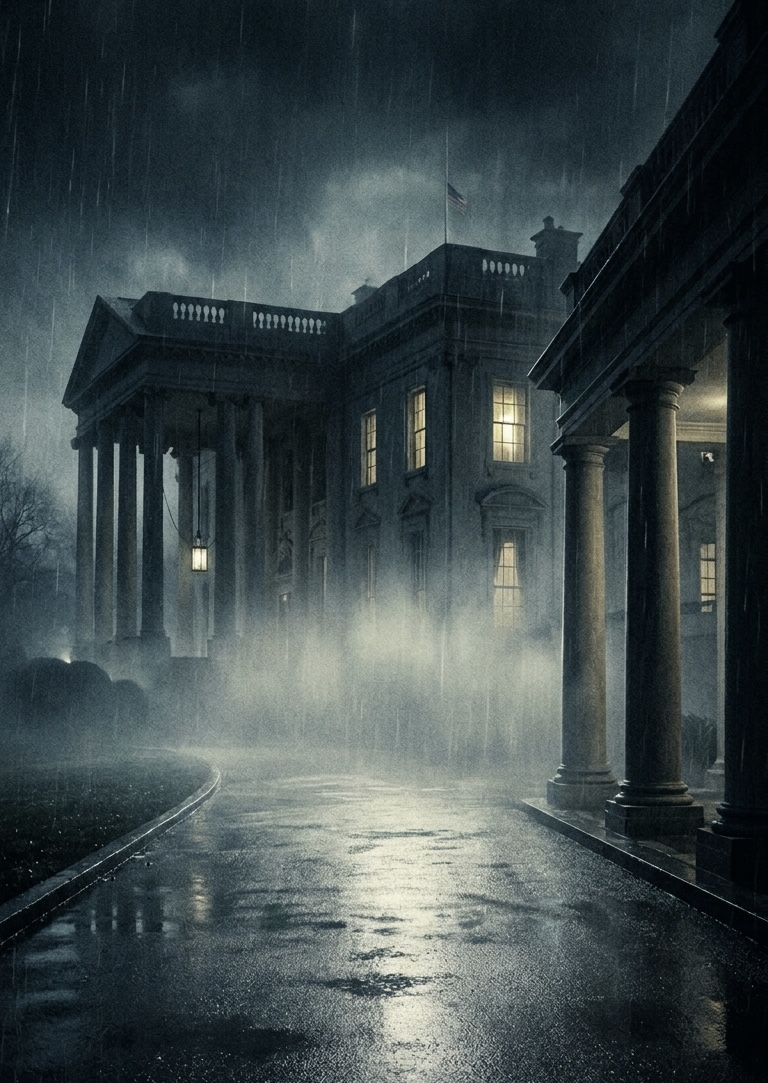
Colton didn't wait for the room to clear. He caught Mika’s eye for a fraction of a second—a silent acknowledgment of camaraderie—and headed for the door. He moved through the carpeted silence of the West Wing, past the portraits of former presidents who prided themselves as “pillars of institutional stability”. Colton reached the basement exit, the rain was incessant and oppressive. Agent Andy drove up to Colton in his black SUV, the brilliant LED headlights briefly blinding him. Colton climbed in and shut the door.
“Where to, sir?” Agent Andy inquired.
“The garage,” Colton replied coolly.
Agent Andy gave a curt nod and put the car in drive.
The rain pelted the roof of the armored SUV like a thousand bullets as it pulled away from the West Wing, carving paths through the city grime. Mike Colton didn’t look at the passing monuments. To him, the National Mall might as well have been an open-air strip mall, and the Capitol a wasp’s nest in need of fumigating.
As the SUV came to a halt next to a black sedan in a dark corner of the P3 level of the parking garage, Colton eyed the middle-aged man dressed in a ruffled dress shirt and a wrinkled necktie. He looked like an innocuous, overworked tax accountant.
Colton stepped out.
“What’ve you got for me, Vince?” Colton asked.
Vince Morello didn't exist on any government payroll. He was a "consultant" whose fees were paid through a series of shell companies that specialized in "market research" for the OEEA.
Morello was the man Colton called when he needed a murder weapon that couldn't be traced back to the armory.
Morello handed Colton an envelope. “Shanahan is cleaner than most,” he said. “No mistresses, no secret bank accounts in the Caymans, nothing. He’s a complete bore.”
Colton took the envelope but didn't open it. “Squeaky clean, eh? Can’t say I’m not surprised.”
“It’s not him, Mike,” Morello said, his voice dropping an octave. “It’s the kid. Patrick Jr. High-stakes gambling debt to the Irish mob. The Southie bookies.”
Colton raised an eyebrow. “The Irish mob, Vince?" he asked, his voice nearly a whisper. "In Southie? I thought they all retired to sell real estate after Bulger went on the run.”
"The game hasn’t changed; it’s just less obvious nowadays,” Vince said. "But it’s not Winter Hill’s game anymore, it’s their nephews and cousins. They run the books out of a half-dozen taverns and ‘social clubs’ from Dorchester to Charlestown. Pat Jr. didn't just lose money; he lost it to the wrong kind of Townies. He’s in for four hundred thousand, and the vig is doubling every month he plays hide-and-seek."
"And I presume the Speaker is covering it?”
"He’s trying. But that’s only half the leak in the boat," Vince said, handing Colton a second, thinner envelope. "There’s a girl. Siobhan O’Malley. Everyone calls her Sally.”
“Siobhan,” Colton spat. “What is it with Micks giving their kids fucking leprechaun names?”
Vince let out a raspy chuckle. “I wish I knew, Mike. She’s the daughter of a retired BPD captain—old school, connected, knew Whitey Bulger. Sally’s got a mean streak a mile wide, just like her old man. She and Junior were an item for two years. She knows where the bodies are buried, Mike. Literally."
Colton opened the envelope. Inside were grainy photos of Pat Jr. looking disheveled, high, and in places he shouldn't be. There was also a copy of a digital transcript with highlighted notations in the margins.
Colton took a cursory glance at the notes. He gleaned all the information he needed. “She’s extorting him?"
"Every dime he doesn't give the bookies, he’s giving to her to keep her mouth shut about a hit-and-run in Quincy three years ago," Vince said. "The Speaker’s office made the police report disappear, but Sally kept the receipts. She’s essentially a silent partner in the Shanahan family trust now. She’s squeezing the kid for everything he’s worth because she knows the old man can afford it."
Colton looked at the photos. In one, Pat Jr. was crying, leaning against a brick wall in a gritty alleyway that looked like it belonged in a 1970s crime flick.
"The Speaker has presidential ambitions," Colton stated, his eyes narrowing. “This isn't just a scandal, Vince. This is the Tsar Bomb to Shanahan’s chair. If this hits the Globe, the Shanahan name becomes a curse word in Massachusetts."
"So, what’s the move?" Vince asked. "Do we pay her off? Or do we make her go away?"
Colton tucked the envelopes into the inner pocket of his coat, feeling the weight of the leverage against his chest.
"Neither," Colton said coldly. "We don't want lady leprechaun to go away. She could be our lead witness. And we won’t pay Pat Jr.’s debt. We’ll buy it."
Vince paused. "You want to own the debt to the Southie bookies? Are you fucking nuts, Mike?”
"I want to own the Speaker, Vince. And you can't own a man if you've already solved all his problems." Colton handed Vince a single envelope. “Here’s your taste. Keep me posted.”
He turned away from the black sedan, his mind already calculating the conversation he would have with the Speaker. He wouldn't meet him in his office. He needed somewhere with the smell of incense and the weight of God.
The interior of St. Peter’s on Capitol Hill was a cavern of flickering amber and cold stone. At 6:00 AM, the air was thick with the scent of beeswax and the ghosts of a thousand hushed confessions. For Speaker Patrick Shanahan Sr., this was the only place in Washington where the "Wolves" couldn't reach him. Here, he wasn't the third most powerful man in the free world; he was a sinner in search of a miracle.
Shanahan sat in his usual pew, the fourth from the front, his head bowed. His fingers moved rhythmically over a set of worn Irish horn beads. “Holy Mary, Mother of God, pray for us sinners...”
He was praying for Pat Jr. He was praying for the girl, Sally O’Malley. He was praying for the hit-and-run in Quincy to stay buried in the salt marshes where it belonged. He believed in the power of consecrated ground. He believed that within these walls, he was under a divine Aegis.
The heavy oak doors at the back of the nave groaned, then clicked shut.
The sound of footsteps—slow, deliberate, and clicking sharply against the marble—echoed through the silence. They didn't sound like the hesitant shuffle of a parishioner. They sounded like a countdown.
Shanahan didn't look up until the cold draft hit him. A figure slid into the pew, sitting exactly two feet away. Not a demon in red, but a man in a navy suit that cost more than the Speaker's first car.
“You’re late for the Sorrowful Mysteries, Mr. Speaker,” Mike Colton said, his voice a low, dry rasp that seemed to suck the warmth out of the air.
Shanahan stiffened, his knuckles whitening around his rosary. He turned his head, his tired, watery eyes wide with a mix of confusion and mounting dread. “Colton? What in God’s name are you doing here?”
“I’m here for the same reason you are,” Colton replied, staring straight ahead at the crucifix above the altar. “I’m looking for a resolution to a very difficult problem.”
“This is a house of prayer,” Shanahan hissed, his Boston accent thickening with indignation. “If the President has a message, he can send it to my office at nine.”
“The President has breakfast with the First Lady at nine.” Colton said. He finally turned his head, his eyes as void of light as a shark's. “And I think we both know your office is currently being monitored by people who don’t have your best interests at heart. People like Sally O’Malley. Or the men from the 'social clubs' in Southie who are tired of waiting for their four hundred grand.”
The rosary beads slipped from Shanahan’s hand, clattering against the wooden kneeler like falling teeth. The Aegis was gone. The demon was inside the circle.
“How do you…” Shanahan’s voice broke.
“I know about the hit-and-run, Patrick. I know about the BPD captain who shredded the report. And I know that Sally is a very ambitious girl who realizes she’s holding a winning lottery ticket.” Colton leaned in closer, his presence a suffocating weight. “You’re looking for a miracle? I’m the closest thing you’re going to get.”
“You’re a devil,” Shanahan whispered, his face pale.
“I’m not here to bargain for your soul. I’m here to save it,” Colton countered. “I can make the debt go away. I can buy the paper from the bookies. I can ensure that Sally O’Malley finds a very lucrative reason to move to the West Coast and forget she ever knew your son’s name.”
Shanahan let out a shaky breath, a spark of desperate hope flickering in his eyes. “You’d do that? Why?”
“Because the President needs a Speaker who isn't distracted by family tragedies. He needs a Speaker who understands that ‘good faith’ is a luxury for people who don’t have skeletons in Quincy.” Colton’s voice dropped to a conspiratorial silk. “Yield the chair, Patrick. Step down for ‘health reasons.’ Support the Motion to Vacate. In exchange, I become your son’s guardian angel. The debt vanishes. The girl disappears. Your legacy remains intact.”
Shanahan looked up at the cross, then back at Colton. The "temptation" was laid bare: political suicide in exchange for familial tranquility.
“And if I refuse?”
Colton stood up, the movement fluid and predatory. He adjusted his coat, the envelopes from Vince crinkling audibly in his pocket.
“God may forgive, Mr. Speaker,” Colton sneered, “But I don’t.”
Colton didn't wait for an answer. He turned and strode back down the aisle, his footsteps echoing like a gavel. He left Shanahan alone in the pews, clutching his beads and realizing for the first time that there was no more sacred ground left in the city.
Colton stepped out of the heavy oak doors and back into the damp early morning air of D.C. As Colton climbed into the back of the idling SUV, he took out the envelopes from his jacket. He hadn’t opened them since his meeting with Vince.
“Alright, Andy,” Colton said, his voice low with a subtle tinge of exhaustion. “Let’s go home.”




Really loved how you built that tense atmosphere around the wolves it made the setting feel alive and a bit unsettling in the best way, especially the way their presence lingers even when they’re not on the page. I’m curious though, are the wolves meant to be purely symbolic, or will we see more of their deeper connection to the main conflict as the story goes on?
I think on the one hand, the wolves are symbolic of the silent power behind the presidential advisors can have and, how that power can be harnessed by the chief executive in a kind of modern twist of the Jacksonian spoils system. On the other hand, they are three dimensional (or at least I'm trying to make them) characters with flaws and blindspots, like we all have. You will see more of a deeper connection as the narrative progresses. The common denominator among them is their personal loyalty to the President. Cabinet secretaries may be "loyal to the office", but the wolves are loyal to the man and I think that is a more.. "corrupting" form of loyalty. I hope that answers your question, thanks for reading!